Oh, East is East, and West is West, and never the twain shall meet, Till Earth and Sky stand presently at God’s great Judgment Seat. — Rudyard Kipling, “The Ballad of East and West”

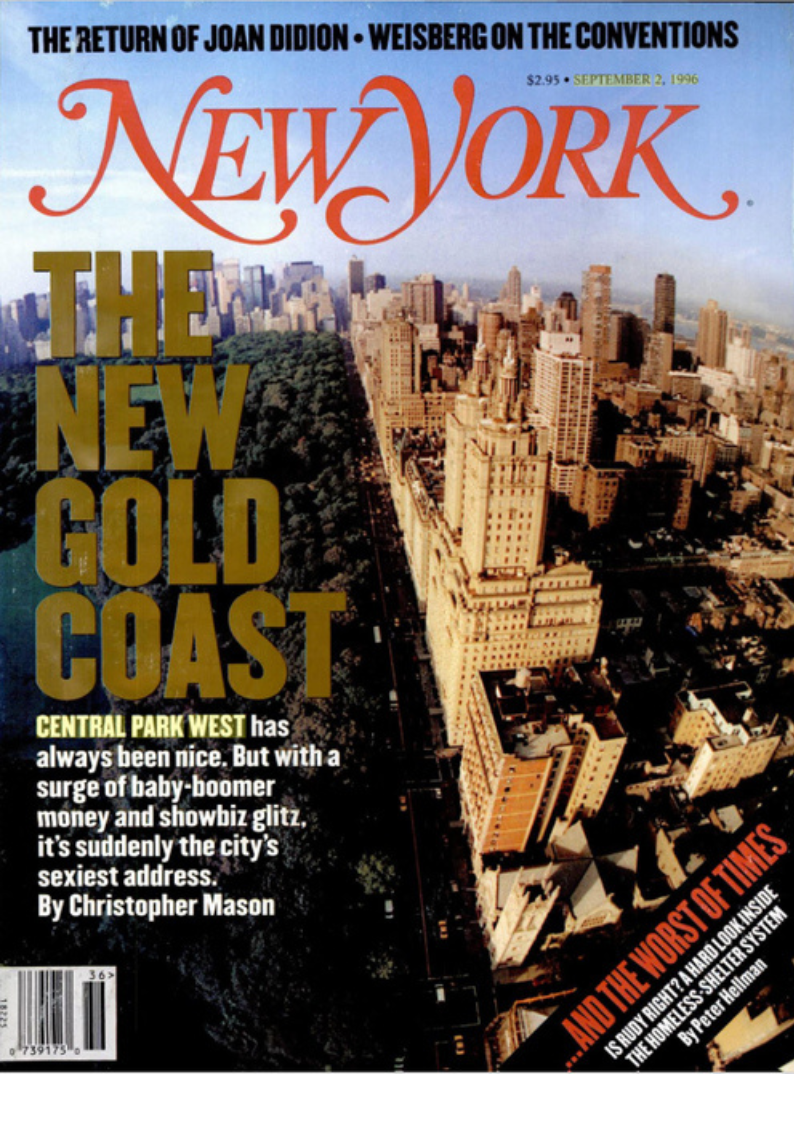
CENTRAL PARK WEST, CURIOUSLY, HAS BECOME MANHATTAN’S new gold coast. Prices for luxury apartments along the western avenue—from Donald Trump’s flashy new condominium at Columbus Circle to the dignified Beresford at 81st Street and beyond—are now actually exceeding foods for comparably sized spreads on Park Avenue and are inching closer than ever to sales figures on almighty Fifth.
Such news may be unthinkable to Upper East Siders who reflexively disdain Central Park West as the far-flung home of lefties and a funky refuge for those unable to make the grade socially and financially at the blue-chip co-op fortresses in the 10021 Zip Code.
“Everyone I knew, including my shrink, told me I was crazy to move to Central Park West,” says Helen Gurley Brown, editor-in-chief of Cosmopolitan, who adds that her husband David “dragged” her to the Beresford from Park Avenue twenty years ago. “The citadels of big money may still be mostly on Fifth and Park,” she says, “but lately it seems like everyone wants to move to Central Park West. We get letters from brokers offering to appraise our apartment every week.”
The grapefruit trees on the terrace of their penthouse triplex facing east, south, and west even have their own bumblebee, says David Brown, who declines to name the six-figure price he paid for the apartment in 1976: “Let’s just say it was one of my best investments.”
Brown is one of the few who remember visiting Central Park West when it still had a streetcar. How does he think it’s changed? “It’s become Waspier,” he says, chuckling. “It’s no longer déclassé to live on Central Park West. I see refugees from Park and Fifth moving in, and I tease them that I’m glad to see the stigma of the arts hasn’t put them off.”

Of course, Central Park West’s artists are not the kind starving in garrets. The pop musician Sting, for example, owns a 7,000-square-foot, eighteen-room duplex at 88 Central Park West, featuring both formal and family dining rooms, a library, and an office; he bought it from the pop musician Billy Joel in 1988 for $4.8 million. And Kevin Bacon and Kyra Sedgwick just snapped up an apartment on the ninth floor at the Beaux Arts St. Urban for $1.9 million—a 3,000-square-foot facing north and east. “The list of famous people who live here is incredible,” says David Brown. “I’m amazed that no one’s ever thought of publishing a Map of the Stars for Central Park West like they have in California.” (See “Avenue of the Stars,” below.)
The showbizzy milieu is not, of course, the only thing that distinguishes West from East. “There’s a different respect for new money on the West Side,” says Linda Stein, the exuberant real-estate broker known for her roster of Hollywood-celebrity clients. “The excitement is about how much, not when it was made. At co-ops on Fifth and Park, new money is frowned upon. On Central Park West it is worshiped.”
There’s something of a generational shift as well. People who came of age in the sixties and seventies tend to be turned off or intimidated by the starchiness of Fifth Avenue, and more and more of those baby-boomers are now in the market for posh uptown apartments. “Fifth Avenue is the perfect buy for insecure Wall Streeters and social climbers,” says one West Side art collector. “You can detect a great suppression of sexuality, ethnicity, and creativity over there.”
One Park Avenue socialite has an equally acid opinion of the West Side. “It can get pretty uncivilized,” she says, lips pursed. “It’s nothing like walking over to Madison or Park from Fifth. And the East Side delivery service is so much better. Let’s face it—the West Side’s still a little honky-tonk. There’s no Gracious Home over there.”
Many brokers speak of the significant divide between East and West. “It’s bizarre,” says Barbara Corcoran, the chairman of the Corcoran Group. “A lot of East Siders seem to think that living on Central Park West, or anywhere on the West Side, is like living in China or, even worse, New Jersey,” she says. “And the vast majority think of Central Park West as being ethnic, casual, and far more bohemian than it actually is.”
How about West Siders’ perceptions of the East Side? “I’m always hearing the same three words,” says Corcoran. “Waspy, Republican, and formal.“
THE BERESFORD “Everyone I knew, including my shrink, told me I was crazy to move to Central Park West,” says resident Helen Gurley Brown.
“At co-ops on Fifth and Park, new money is frowned upon,” says real-estate broker Linda Stein. “On Central Park West, it is worshiped.”

AVENUE OF THE STARS:
(Some buildings listed here are not technically on Central Park West but are considered CPW real estate by brokers.)
TRUMP INTERNATIONAL: 1 Central Park West
Donald and Marla Trump.
THE CENTURY: 25 Central Park West
Kimba Wood.
HARPERLEY HALL: 41 Central Park West
Carol Kane
Geraldine Laybourne
Madonna
Forrest Sawyer
Arthur “Pinch” Sulzberger Jr.
55 CENTRAL PARK WEST
Keith Barish
John Lone
Seymour Stein
Jann Wenner and Matt Nye
Tim and Nina Zagat.
75 CENTRAL PARK WEST
Carroll O’Connor.
1 WEST 67TH STREET
Joel Grey
LeRoy Neiman
Johnny Pigozzi.
2 WEST 67TH STREET
Kelly Klein
Arthur Penn.
88 CENTRAL PARK WEST
Celeste Holm
Lorne Michaels
Paul Simon
Sting
Harvey Weinstein.
91 CENTRAL PARK WEST
Robert Caro
Liam Neeson and Natasha Richardson.
101 CENTRAL PARK WEST
Harrison Ford and Melissa Mathison
Peter Jennings
Rick Moranis.
THE MAJESTIC: 115 Central Park West
Kathleen Battle
Brandon Tartikoff.
THE DAKOTA: 1 West 72nd Street
Lauren Bacall
Graydon Carter
Roberta Flack
Yoko Ono
Maury Povich and Connie Chung
Rex Reed.
THE LANGHAM: 135 Central Park West
Lenny Holzer
James Levine
Carly Simon.
THE SAN REMO: 145 Central Park West
Marshall Brickman
Don Hewitt
Dustin Hoffman
Steve Jobs
Princess Yasmin Aga Khan
Steve Martin
Elaine May
Demi Moore and Bruce Willis
Scott Rudin
Steven Spielberg and Kate Capshaw
Andrew Tobias.
THE KENILWORTH: 151 Central Park West
Diandra Douglas
Ashton Hawkins
Bill Moyers.
44 WEST 77TH STREET
Christie Brinkley
Sandy Duncan
Lynn Nesbit.
THE BERESFORD: 211 Central Park West 1 and 7 West 81st Street
David Brown and Helen Gurley Brown
Patrick Demarchelier
Robert Forbes
Richard Holbrooke and Kati Marton
Sidney Lumet
John McEnroe and Patty Smyth
Phyllis Newman and Adolph Green
Tony Randall
Beverly Sills
Isaac Stern
Elizabeth Strong de Cuevas.
15 WEST 81ST STREET
Billy Baldwin and Chynna Phillips
Ian Schrager.
THE BOLIVAR: 230 Central Park West
Betsy von Furstenberg
Jerry Seinfeld.
271 CENTRAL PARK WEST
Robin Williams.
279 CENTRAL PARK WEST
Ann and Mick Jones.
THE ST. URBAN: 285 Central Park West
Kevin Bacon and Kyra Sedgwick
Ed Bradley.
THE ELDORADO: 300 Central Park West
Alec Baldwin and Kim Basinger
Richard Dreyfuss
Garrison Keillor
Tatum O’Neal
Sandy Pittman
Pinchas Zuckerman.
THE ARDSLEY: 320 Central Park West
Barbra Streisand.
336 CENTRAL PARK WEST
Twyla Tharp.
353 CENTRAL PARK WEST
Al Pacino.
Central Park Westies “only have to deal with one parade a year—Thanksgiving—as opposed to dozens on Fifth,” says broker Dan Douglas.
Among Central Park West’s newest inhabitants are Hollywood celebrities fleeing the earthquakes, riots, fires, floods, and verdicts of Los Angeles and brash young bond traders, buoyed by a twelve-year bull market. Those spotted looking on the avenue recently include Nicolas Cage, Chazz Palminteri, Conan O’Brien, Ricki Lake, and Donna Karan (who is said to have almost spent $6 million two weeks ago on three apartments at 279 Central Park West but backed out at the last minute).

The attribute most feverishly sought, not surprisingly, is a view of the park. On both Central Park West and Fifth Avenue, apartments with such views can command prices that are 50 to 100 percent higher than those without. Terraces are also prized, but many scoffed at the scene in the first episode of CBS’s beleaguered Central Park West in which Mariel Hemingway eats breakfast en plein air in a white terry-cloth robe. “Puh-leeze,” says one broker. “If you ask me, terraces are a joke. No one uses them. They’re always filthy and covered in soot. I mean, it’s not like living in Beverly Hills, where you always have a maid to hose down your lawn furniture at dawn. But everybody wants them.” Neighbors who overlook Barbra Streisand’s terrace at the Ardsley claim she’s never once set foot on it.
TRUMP INTERNATIONAL (1 CENTRAL PARK WEST) David Letterman grabbed a hard hat to inspect the view himself.
According to Susan Renfrew, director of West Side sales at Halstead Realty, average prices per room for sales on Central Park West have shot up by 31 percent in the past two years, from $147,000 to $207,000, compared with a more modest 22 percent on Fifth ($224,000 to $283,000) and 24 percent ($152,000 to $199,000) on Park. Barbara Corcoran confirms the trend. “We’ve watched the difference in prices between Fifth and Central Park West narrow dramatically from 42 percent in 1982 to only 14 percent in the last year,” she says. “It’s unbelievable.” The only problem, it seems, is availability. “Right now I could sell an apartment on Central Park West with 5,000 square feet and a terrace for 3 to 5 million bucks about fifteen times over,” says Robby Browne at Douglas Elliman. “There just isn’t enough inventory.”
Apartments on Central Park West’s Golden Mile, the twenty-block stretch from Columbus Circle to the Beresford, do not linger on the market for long these days. One on the thirteenth floor at the San Remo, with eight rooms, recently changed hands at astonishing speed. First listed on April 18, it sold only three days later for $3.2 million. The buyer was Gary David Goldberg, an executive producer of Spin City, Michael J. Fox’s new, New York–based sitcom on ABC. (The last time the apartment turned over was in 1984, for just $1.6 million.) And hoping to capitalize on the present feeding frenzy, Carnegie Hall president Isaac Stern and his wife, Vera, who are divorcing, have put their nineteenth- and-twentieth-floor duplex at the Beresford with a large terrace on the market for an ambitious $4.895 million. Friends say Stern will continue to live in an apartment on the second floor that he also owns.
“I have clients with millions to spend who have been reduced to renting temporary apartments until something great on Central Park West becomes available,” says John Burger, a broker at Brown, Harris, Stevens. “It’s incredibly frustrating.” “I can’t tell you how many calls I get from folks with big apartments on the East Side who want to move to Central Park West for something ‘fun’ and ‘different’ and think that by crossing the park they’ll get a great deal,” says broker Robby Browne. “Forget it. Those days are over.”
With apartments in the neighboring Dakota and San Remo trading for millions, those at the rent-stabilized prewar Langham, at 73rd Street, are regarded with considerable envy. “My broker warned me no one would ever visit me when I moved here 25 years ago,” says Peter Brown, the British-born publicity consultant who represents Andrew Lloyd Webber. “She warned me that Central Park West was unsafe and unfashionable, and she was right.” Clearly, times have changed: Prince Edward, the Queen of England’s youngest son, was Brown’s houseguest last month. Also at the Langham are Carly Simon and conductor James Levine.
Linda Stein is convinced it is the siren call of fame that beckons. “If the eighties were about money, the nineties are about celebrity,” she says. “A lot of people get excited about the idea of living on the same street as some of the world’s greatest movie stars, directors, writers, and musicians. The architecture doesn’t hurt, either. And the fact that major celebrities have paid top dollar on Central Park West has definitely contributed to the rise in the market.” Stein is known among brokers for having pulled off the two highest-priced deals ever on Central Park West, both at the San Remo. Bruce Willis and Demi Moore paid $8 million, which definitely contributed to the rise in the market.”
Stein is known among brokers for having pulled off the two highest-priced deals ever on Central Park West, both at the San Remo. Bruce Willis and Demi Moore paid $8 million in 1990 for the penthouse triplex in the south tower that was owned by producer Robert Stigwood and once belonged to Eddie Cantor. And Steven Spielberg and his wife, Kate Capshaw, paid handsomely for two apartments on the sixteenth floor. A friend of Capshaw’s says that she looked on Fifth Avenue but “didn’t like the vibes.”
Linda Stein won’t divulge exactly how much Spielberg paid, but San Remo neighbors estimate the selling price for the two apartments to be in excess of $7.5 million and calculate the monthly maintenance for the 6,000-square-foot apartment to be in the neighborhood of $6,000, a relative bargain compared with charges at the nearby Dakota, where hefty expenses for the more historic building are shared by fewer stockholders. (Yoko Ono, for instance, whose park-facing apartment and office at the Dakota also have a combined square-footage of close to 6,000, is currently paying a monthly maintenance of $12,566.)
Among Bruce & Demi & Steven & Kate’s celebrated San Remo neighbors are Dustin Hoffman, producer Scott Rudin, and Steve Martin, who also joined two apartments together while married to actress Victoria Tennant. He had proved his devotion to the building by choosing to remain there even after their bitter divorce; Martin restored the wall between the two units, and Tennant, now remarried, lives next door. Neighbors say he is plainly irritated at having to share the same elevator landing with the newlyweds.
Until the Spielbergs move into the San Remo, they remain at Trump Tower while architects Gwathmey Siegel oversee noisy renovations to their thirteen-room terraced apartment, which have been the subject of complaints from neighbors. Spielberg recently offered to rent outside office space for his neighbors, who include Marilyn Berger, a first-string obituary writer at the New York Times and the wife of 60 Minutes executive producer Don Hewitt, and Nina Brickman, a film editor and the wife of screenwriter-director Marshall Brickman. (Their apartments are, respectively, above and below his.)
What else fuels the new yearning for a Central Park West address? If you believe Donald Trump, the answer is simple: Donald Trump. “I’m pleased to see that the tremendous success of Trump International has led to the resurgence on Central Park West,” he says. “Sales are through the roof. It’s the most successful condominium ever built in this country.” The developer is moving from his current Fifth Avenue aerie at Trump Tower into a Trump International penthouse.
Paul Beirne, a partner at the investment-banking firm Sanford C. Bernstein & Co., who recently moved into the nearby Century (Central Park West’s sole prewar condominium), considers Trump International a blessing. “I’m not crazy about the way it looks, but it will make Columbus Circle safer and there’ll probably be more cabs,” he says.
Other advantages of Central Park West, says Dan Douglas, a Corcoran Group broker, are lower maintenances (often 25 percent less than on Fifth and Park, where real-estate taxes are higher) and less exacting cash requirements for purchase (which can be as high as 100 percent at East Side co-ops). Then there’s the much-trumpeted West Side renaissance—the arrival of the California-mall-style Lincoln Square Cinema; the World, Reebok, and Equinox gyms; two sprawling Barnes & Noble bookstores on Broadway; and a cavalcade of popular restaurants such as Ansonia, Savann, and Rain. And who can dispute the luxury of having Carnegie Hall, Lincoln Center, Fairway, and Zabar’s within walking distance?
“You only have to deal with one parade a year—Thanksgiving—as opposed to dozens on Fifth,” adds Dan Douglas. And most brokers interviewed said that the co-op boards are easier, although that’s beginning to change. “They’re still less intimidating,” says Browne, who claims that issues of sexual preference, race, and religion are inconsequential on Central Park West. “If your financials are okay and you seem like a decent person, there’s usually no problem.”
Such liberal standards do not always apply, however. Despite, or perhaps because of, their wealth and fame, several celebrities seeking to lavish millions on Central Park West co-ops have had to endure the withering stigma of rejection. Such was the case for Cher at the Dakota and Madonna at the San Remo. Fame may be grand, but excessive fame, it seems, is irksome. “When you’re the kind of celebrity who requires bodyguards to protect you from a bunch of screaming teenagers outside your building, it’s definitely a problem,” says Linda Stein.
Undaunted, Madonna wound up on Central Park West anyway, circumventing the nettlesome issue of board approval at 1 West 64th Street by purchasing a five-room apartment directly from the building’s sponsor. Expanding since then, she has bought up so many adjoining apartments that no one need fret about there being sufficient space this October for Madonna and child.
Excessive youth and a somewhat dissolute mien appear to have been the stumbling blocks for Sean Lennon, who was 20 when he was turned down at 88 Central Park West in 1995 (despite having grown up only two blocks north, at the infinitely more prestigious Dakota). “You only have to know his last name to know that paying the maintenance wasn’t the problem,” says one broker. Young Lennon is now installed on Duane Street in TriBeCa.
Turned down at the San Remo, Calvin Klein moved to the East Side in 1988, buying a 10,000-square-foot townhouse at 16 East 76th Street for $6.95 million. “He bought it on an impulse,” says a close friend, “but it was way too big, and he never entertained on a grand scale.” Finding himself financially strapped in 1991, Klein sold the house at the bottom of the market for a mere $4.848 million and moved into the comparatively modest three-bedroom apartment on Central Park West at 67th Street that he had purchased for his future wife, Kelly, from Christie Brinkley for $1.2 million in 1984. (The space features a double-height living room with a park view.) Since the Kleins have split, however, Calvin has been spotted at the East Side’s Carlyle hotel.
After Jann Wenner, the co-owner and editor-in-chief of Rolling Stone, left Jane, his wife of 26 years, for Matt Nye, a former model, the new couple found themselves rejected by the co-op board at the Kenilworth when they tried to sublet Linda Stein’s own apartment. In a touching gesture, Linda’s ex-husband, Seymour Stein, president of Elektra Entertainment, stepped in to offer Wenner and Nye a haven—an empty apartment on the seventeenth floor at 55 Central Park West that he had bought to create a duplex with his own apartment below, for $17,000 a month.
Having now decided to settle down and find themselves a home they can call their own, Jann and Matt have bought a five-story, fully renovated, central-air-conditioned townhouse on West 69th Street. Once ensconced, Wenner, a famously devoted father, will be only a block away from his children and estranged wife on 70th Street. (Seymour Stein has since opted to put Wenner and Nye’s Central Park West garçonière on the market. Purchased for $2.2 million in 1991, it is currently under contract for $3.2 million.)
Rebuffed at the ultraconservative One Beekman Place, on the East Side, Barbra Streisand continues to live in the Art Deco apartment at the Ardsley that she once shared with her ex-husband Elliott Gould. Oddly, the apartment faces west and has no view of the park. “She tells people she keeps it for sentimental reasons,” says one broker, rolling his eyes.
FOR MANY, CENTRAL PARK WEST’S MYSTIQUE DERIVES FROM ITS evocatively named bastions of prewar grandeur. Most celebrated, of course, are the Dakota, the avenue’s oldest apartment building, built in 1884, the Beresford (1929), the Majestic (1930), the San Remo (1930), and the Eldorado (1931), all of which define the avenue’s skyline with their distinctive towers. Even No. 55, which has no official name, is known as “the Ghostbusters building,” after the movie filmed there in 1983.
On the Upper East Side, however, a hushed tone is reserved for the numbers of the neighborhood’s grandest buildings: 820, 834, 960, and 1040 Fifth Avenue, and 720, 730, 765, 770, and 740 Park Avenue.
Why do so many of Central Park West’s buildings have names? According to Paul Goldberger, chief cultural correspondent and longtime New York Times architecture critic, the phenomenon is largely explained by the fact that several of its most famous buildings were constructed on the sites of residential hotels of the same name, such as the Beresford, the Majestic, and the San Remo. The Century replaced the Century Theater, where a young Irving Berlin sang “Oh, How I Hate to Get Up in the Morning” in a 1918 wartime revue. A notable exception, Goldberger points out, is the Dakota, so named by its builder, Edward Clark, an heir to the Singer Sewing Machine fortune, because it was at a far remove from the fashionable part of town. (Today, East Siders descend in droves upon the Dakota when a great apartment becomes available, says Patricia S. Burnham of the eponymous firm, who sold to Connie Chung and Maury Povich.) Distinguished prewar residential buildings with grandiose names can also be found elsewhere on the West Side: the Osbourne way; and Gainsborough Studios (1908), on Central Park South. And developers have gleefully embraced the tradition at such latter-day additions to the West Side as the Alexandria, the Coronado, and the Park Millennium.
“Park and Fifth developed quite differently from Central Park West,” says Goldberger. “Fifth was lined with mansions, and early Park Avenue had more modest residential dwellings. What’s interesting is that buildings on the East Side were considered to have sheer address value. There was a sense then, which still applies today, that having a name is a tiny bit déclassé. There’s a sense that names spring from a period when the street had to try a little too hard.” Goldberger adds that when 101 Central Park West was built in 1930, specifically to accommodate well-to-do Jews excluded from socially restricted buildings on Fifth Avenue, it was deliberately left unnamed to emulate Fifth Avenue. On the East Side, the few buildings that bore names eventually dropped them. One such instance is the elegant 32 East 64th Street, between Madison and Park Avenues, whose blueprints refer to it as the Verona.
Goldberger tells the story of tenants at 15 West 81st Street, chagrined that their apartment house was perceived as being less chic than its named neighbor, the Beresford, debating several years ago whether to invent a name for their own building. “Okay,” said one in exasperation. “Let’s call it 1040 Fifth Avenue” (famously the address of the late Jacqueline Kennedy Onassis).
Today, as with the East Side, a definite pecking order exists for buildings on Central Park West. The top five buildings, most brokers agree, are the Dakota (historical prestige, grand scale, famous residents), the Beresford (dazzling southern views), the San Remo (greatest number of celebrities and stunning views of the park and lake), 88 (high ceilings and large picture windows), and 101 (superbly run). Realtors also refer to a “second tier,” which includes the Majestic, the Eldorado, the Kenilworth, the Prasada, the St. Urban, 55, 75, 91, and the White House at 86th Street.
“MY THEORY IS THAT CENTRAL PARK WEST AWOKE PEOPLE TO its charms, even though the show was a flop,” says Chappy Morris, a private investor and a perennial fixture on junior committees. Morris just contracted to sell his penthouse at the Alden to a neighbor, who will inherit his terrace croquet lawn and jacuzzi.
Why did he sell? “The truth is I prefer the East Side,” he says, gazing longingly across the park. “That’s where I grew up and where most of the people I know and the parties I go to are. I miss being close to my old haunts, like Mortimer’s. When I moved here, I had no idea that those blocks to Columbus and Broadway are so much longer than those on the East Side. It’s faster to take a cab to Madison than it is to walk all the way to the stores on Broadway. The other day I realized I hadn’t been to Broadway in months. But what really drives me ballistic is when they close the transverses in Central Park. They do it every time there’s heavy rain or some parade on Fifth, and you have to take a cab all the way to 59th Street, so it takes an hour to get to the East Side. It’s a nightmare.”
So why did he move to Central Park West in the first place? “I wanted to see what it was like,” he says. “I loved the idea that it was younger and more informal. But none of the restaurants are any good. There’s only Cafe Luxembourg and Isabella’s on Columbus. And that’s always packed. I’m telling you, I can’t wait to move back to the East Side.” But Morris confesses he’ll miss the view. “It’s weird, but somehow it’s more interesting to be looking east at sunset.”
Views of the park—the equivalent of waterfront property in other cities—are considered to be superior on Central Park West because they offer the more appealing perspective of the Plaza Hotel, the Pierre, the Sherry Netherland, and other landmarks such as the Empire State and Chrysler buildings. “On Fifth,” says broker Linda Stein, “you can’t expect great park views from the bedrooms—they’re usually stretched out along the side streets—whereas on Central Park West, where most of the buildings are wider, you have a better chance of having a park view and more light.” Many of the apartment buildings on Fifth are narrow because they were built to replace the relatively slender individual townhouses that once lined the street. (The thinnest is 969, which is just 24 feet wide.)
WENDY WASSERSTEIN, THE PULITZER PRIZE-WINNING PLAYwright, considers herself exempt from the intense disdain and rivalry between the opposing sides of the park. “I’m a crosstown-bus kinda girl,” she says. “I grew up on the East Side and went to Calhoun on the West Side, and I always went on dates with guys who knew how to make a move when the bus swerved going through the park at 79th Street.” Having sold her apartment in “the Madonna building,” Wasserstein is currently living in an East Side hotel while work on her new place on Central Park West is completed.
Fabien Baron, the creative director of Harper’s Bazaar, recently moved to East 17th Street to escape “the boredom” of Central Park West. “It’s beautiful up there,” he says. “I loved the grand scale, the people, the light, and the fantastic apartments. Yet there’s a huge gap between the interior and exterior life. You step outside and there’s no one on the street.”
But there will always be those who couldn’t imagine living anywhere else. “It seems to be my destiny,” says Paul Goldberger, who has lived at the Hôtel des Artistes, the Dakota, and the San Remo and will move into the Beresford this fall. For Goldberger, it is not the park that marks the divide between East and West so much as Columbus Avenue. “It’s funny,” he says. “When I tell people on Fifth Avenue where I live, they say, ‘Oh, you live on the West Side.’ And friends on 96th and Broadway say, ‘Oh, you’re practically on the East Side.’ I suppose what I really love is having one foot in each camp.
“And clearly,” he adds, “I’m not the only one.” ■


This cover story was published in New York magazine on September 2, 1996.