Working with Mario is always a great adventure,” says longtime Manhattan society figure Patricia Altschul, fuchsia-caftaned and lounging on a pale-blue-checked bergère in the double drawing room of her new home in Charleston, South Carolina. Mario is, of course, Mario Buatta, the irrepressible New York decorator who glazed the walls of the space in a glowing shade he calls apple-green—a hue which Altschul describes as “very uplifting, whether the day is cloudy or sunny.”
Over Buatta’s 50-plus years in the business of lacquering and swagging, his clients have been remarkably loyal. The Virginia-born Altschul enlisted his services (and good cheer) for three previous large-scale projects, including Southerly, a 30-room Long Island, New York, estate that she shared with her late husband, Arthur G. Altschul, a distinguished financier. Six years ago she sold Southerly and snapped up a smaller but no less stupendous Greek Revival mansion in Charleston’s historic district and conscripted Buatta once more.

Ineffably grand—even by this courtly city’s exalted standards—the 9,500-square-foot, ten-bedroom landmark was completed in the early 1850s for Isaac Jenkins Mikell, an exceptionally prosperous cotton planter. Gigantic columns carved from cypress support the monumental portico, each one crowned with a capital sporting ram’s heads. Beneath the pediment is a tiled piazza where Meyer lemon trees flourish in big clay pots, and between the house and the street is a tranquil walled garden of boxwood arabesques. The effect, Altschul enthuses, is like “living in a Palladian villa in Italy.”
For many years the Mikell mansion had been used as a public library, and it was later divided into apartments. Admired local contractor Richard Marks (whose eponymous firm also created a new butler’s pantry and an airy kitchen) was called in to restore the home to its historic glory. Every surface was revived, as were glorious details like the elaborate plaster ceiling medallions. The efforts were a great success: The house was honored at the Preservation Society of Charleston’s 2012 Carolopolis Awards for outstanding historic preservation.
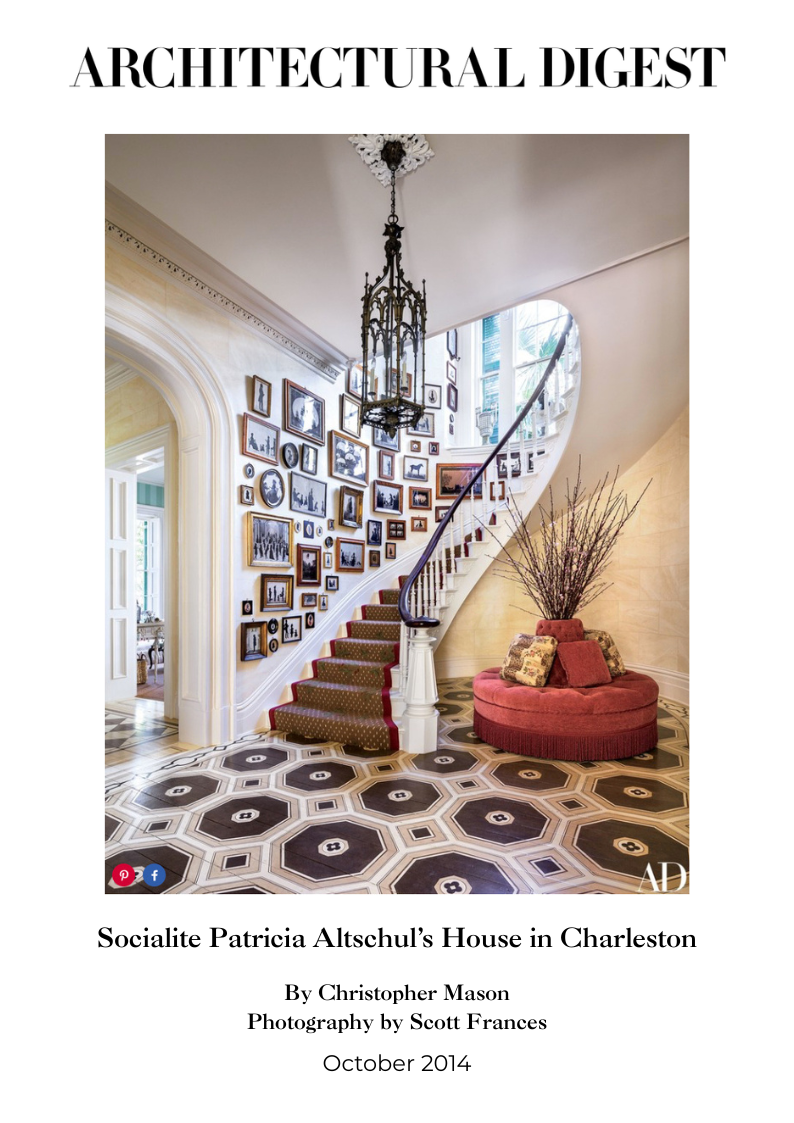
Once the residence was back to its noble self, one vexing problem remained. “The place was too dark,” recalls Altschul. Buatta is a bit blunter: “It had a frumpy beige interior.” To brighten things up, the designer had artisan Haleh Atabeigi paint the entrance hall’s floor white and then stencil it with a lively octagonal pattern based on Victorian tilework. Further lightening the space are walls faux-finished to resemble pale blocks of stone.


The house is furnished with many of Altschul’s favorite decorative elements and objects from her previous Buattafied addresses. Especially choice is the library’s splendid 1760s gilded chinoiserie mirror, which once hung at Keir House in Scotland. Buatta also festooned the dramatic main stairwell with a collection of dozens of striking 18th- and 19th-century silhouette portraits that Altschul inherited and has greatly expanded over time.
The contents may be familiar, but they seem refreshed by their trip below the Mason-Dixon Line. As Altschul marvels, “Everything looks entirely different here, because of the architecture.” The dining room incorporates a large round English table ringed by 19th-century Chippendale-style chairs, all once ensconced at Southerly. The space’s wall covering was brought down from the Long Island estate as well; the Zuber paper depicts Revolutionary War scenes that Altschul says represent a bit of ancestor worship: “A forebear of mine advised George Washington when he defeated Cornwallis at Yorktown.” As for the huge carpet that occupied Southerly’s living room, Buatta blithely chopped it in two and placed one half in each section of the drawing room.
The master bedroom replicates Altschul’s suite on Long Island, including the cheery cornflower-blue–and-white fabric that is used en suite. Decidedly different, however, are this bedroom’s views. “At Southerly I could lie in bed and look at the sea,” Altschul observes. “Here it’s ram’s-head capitals and magnolias.”
Before Buatta’s decor was fully installed, the renovated house and its couture-clad chatelaine made their small-screen debut on Bravo’s Southern Charm, a reality-television series created by Altschul’s son and costar, Whitney Sudler-Smith, who has irreverently described Buatta as “the Dame Edna of decorating.” Renewed for a second season, the frothy program follows the high jinks of a cadre of dapper trust-funders. Altschul is the resident madcap grande dame, a role she clearly enjoys, delivering wry remarks about the cast’s romantic divertissements and her son’s raffish confreres—and when she is ready for a cocktail on the show, she brightly announces, “It’s time for my medicine.”
Buatta himself appeared on Southern Charm as a celebrity aesthete dispensing words of wisdom. (His savoir faire is also being captured in a documentary about his career by Douglas Keeve, who limned fashion star Isaac Mizrahi’s life in the 1995 movie Unzipped.) In that particular episode, the decorator suggests that Altschul enshrine the ashes of her beloved cat, Rocky, who had ascended to feline heaven, in a delft jar above her headboard. Given the hostess’s nonplussed reaction, it seems likely that this is one Buatta design tip she will choose to ignore.
This article was published in Architectural Digest in October 2014.