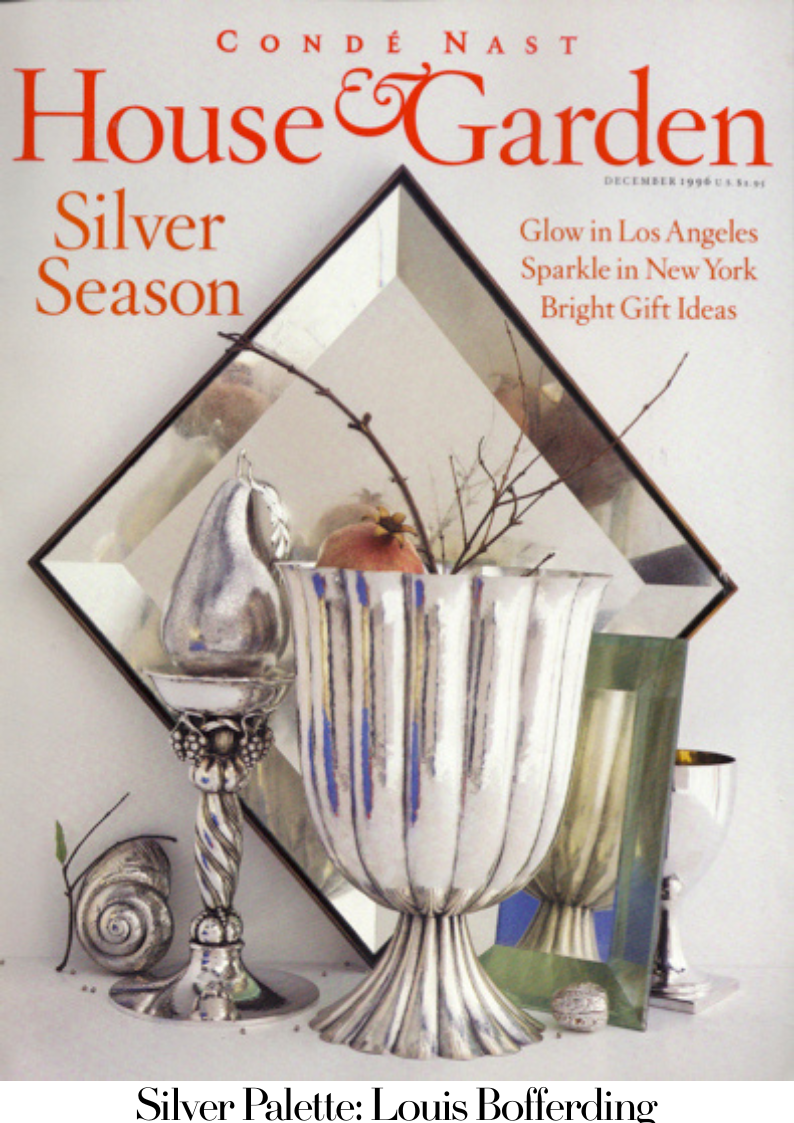
SILVER PALATE
Just when I’m falling in love with them, they leave me,” says Louis Bofferding, glancing at yet another object of his promiscuous affections, a Napoleon III chair upholstered in chartreuse silk, which he is about to part with.
Cohabiting with the eccentrically diverse objects he sells from his stylish apartment on Manhattan’s Upper East Side clearly inspires much rapture and regret for Bofferding, who became a decorative-arts dealer in 1994. And like a demanding lover, his furniture often causes him to lose sleep. “I’ve discovered that living with things that delight me visually can have its drawbacks,” he says ruefully. “The worst by far is always having to turn on the light in the middle of the night to navigate my way to the bathroom —I never know what I’m going to stumble over, because everything’s always being sent out on approval or arriving from Europe. And once the light’s on I’m awake for hours.”
Drawn to the quirky and exotic, Bofferding has stock that ranges from seventeenth-century Italian to I96os French, with a preponderance of pieces designed by influential decorators of the twentieth century, including Jean-Michel Frank, Georges Geoffroy, Stéphane Boudin, and Elsie de Wolfe. “The mix is what inspires me,” he says. “So many of the shops in New York now are all about specialization, which just doesn’t excite me. I only buy things I’m crazy about, that I think will look good together.” Everything in his apartment is for sale, he says, with the possible exception of himself.

Bofferding’s discerning eye has won him many fans among New York’s leading interior designers. His first sale, he recalls gleefully, was a guéridon, designed by Syrie Maugham, that was snapped up by Mark Hampton. Bofferding is “a great sleuth,” says Albert Hadley. “I don’t know how he finds all those wonderful things. He’s always full of surprises.”
“I covet just about everything he has,” says Jeffrey Bilhuber. “He has the surest of eyes and extremely rarefied taste. Not everyone gets it, because it’s not obvious. It’s poetic and appeals to an educated eye.”
Collector Susan Gutfreund agrees. “I think it’s very gutsy of Louis to combine things the way he does,” she says. “Most dealers don’t have the courage. He’s way ahead of the game. I bought an enchanting shagreen breakfast tray from him that doubles as a desk, full of drawers, with a place to put your cup of tea. It was the last thing I was looking for, so finding it felt serendipitous.”

Passionate and well-informed about social history as well as the decorative arts, Bofferding clearly derives plea sure from objects in which those two interests collide. Pointing to a spectacular set of mirrored valances above the windows and doors of his serene drawing room, he is aglow with enthusiasm.
“They belonged to Rose Cumming, the great American tastemaker,” he says, pulling out a book showing the panels as they looked in Cumming’s bedroom, perched above silver lamé curtains.
Everything in Bofferding’s apartment, it seems, inspires an entertaining lec-ture: “Cumming was passing through New York on her way from Australia to England to marry an Englishman when World War I broke out,” he says, “and she wound up as the mistress of Otto Kahn, who set her up with her own shop on Madison Avenue.”

Other items in Bofferding’s drawing room at present include an intriguing collection of chairs inspired by Pauline de Rothschild’s “gallery of chairs at Château de Mouton.” “Chairs are my favorite form of furniture,” says Bofferding. “I’m interested in their sculptural properties, which is probably because I used to be a contemporary art dealer. And if they’re comfortable to sit in, so much the better.”
Asked to explain the provenance of a particular Louis XV cane chair with a hinged seat—a chaise percée —Bofferding grins. “Elsie de Wolfe sat there,” he says, recounting how the legendary decorator incorporated the chair into her bathroom at the Villa Trianon (her celebrated house at Versailles). She used the chair to conceal the essential piece of plumbing she described as “that monstrosity-the unspeakable porcelain fixture.”
With objects of such practicality, charm, and provenance, who could resist?

Published in the December 1996 issue of House & Garden (USA)